
How many square feet will a cubic yard cover? That depends entirely on how deep you want the material to be. A cubic yard is a measure of volume, like a box that’s 3 feet long, 3 feet wide, and 3 feet high. The coverage area of a cubic yard is the flat space it spreads over. To find the coverage area of a cubic yard in square footage per cubic yard depth, you need to know the depth. We can easily calculate cubic yard coverage using a simple formula linking volume, area, and depth. This is a cubic yard to square feet conversion based on a chosen depth.
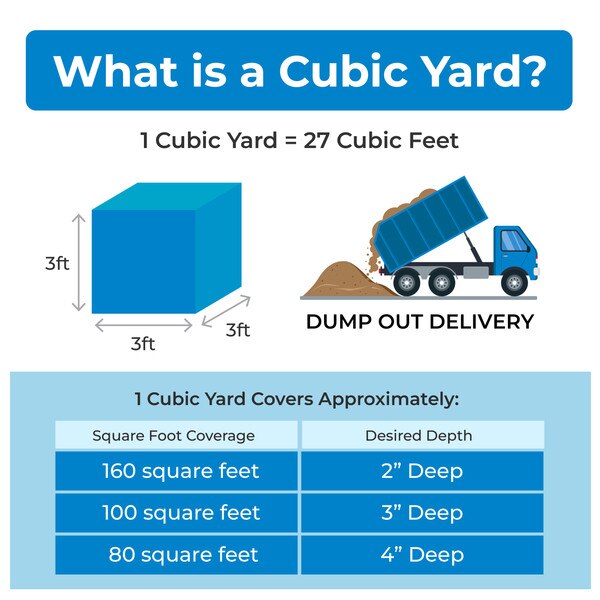
Image Source: www.cumminlandscapesupply.com
Deciphering a Cubic Yard
Let’s start with what a cubic yard is. Think of a cube. Each side of this cube is 1 yard long. Since a yard is 3 feet, this is a cube that is 3 feet on all sides.
Visualizing the Size
Picture a big box. This box is 3 feet tall. It is also 3 feet wide. And it is 3 feet long. That whole box is one cubic yard of space. It’s quite a bit of material! People often order material like soil, mulch, or gravel in cubic yards.
The Cubic Feet Connection
Why 3 feet? Because a yard is 3 feet. To find the volume of the box, you multiply length by width by height.
Volume = Length × Width × Height
Volume = 3 feet × 3 feet × 3 feet
Volume = 27 cubic feet
So, one cubic yard is the same as 27 cubic feet. This 27 cubic feet number is very important for our calculations. It’s the amount of material we have to spread out.
Grasping the Formula: Volume, Area, and Depth
The goal is to find out how much flat ground (area) this 27 cubic feet of material will cover. The amount of ground it covers depends on how thick you spread it. This thickness is the depth.
The Basic Relationship
Think of a simple box again. Its volume is the space inside. If you have material filling this box, the volume is the amount of material.
Volume = Area of the base × Height (or Depth)
Let’s imagine our cubic yard of material is spread out flat over your yard. The area it covers is the base of this spread-out shape. The depth is how thick the layer of material is.
Rearranging for Area
We know the volume (27 cubic feet). We want to find the area (in square feet). We need to pick a depth.
Using the formula:
Volume = Area × Depth
We can move the parts of the formula around to find the area.
If Volume = Area × Depth
Then, Area = Volume / Depth
This is the main formula we will use for cubic yard to square feet conversion: Area in square feet equals the volume in cubic feet (which is 27 for one cubic yard) divided by the depth in feet. This is the core Volume to area conversion formula for our purpose.
Performing the Calculation: Keeping Units Simple
To use the formula Area = Volume / Depth, all your numbers must be in the same unit. Since we want the area in square feet, and our volume is in cubic feet (27), our depth must also be in feet.
Why Feet Are Key
If your volume is in cubic feet, your area will naturally come out in square feet when you divide by depth in feet.
Cubic feet / Feet = (feet × feet × feet) / feet = square feet
If you measure your depth in inches, you must first turn it into feet before using the formula.
Converting Inches to Feet
There are 12 inches in 1 foot.
To convert inches to feet, you divide the number of inches by 12.
Example:
1 inch is 1/12 feet.
2 inches is 2/12 feet.
3 inches is 3/12 feet (or 1/4 feet, or 0.25 feet).
4 inches is 4/12 feet (or 1/3 feet, or about 0.333 feet).
6 inches is 6/12 feet (or 1/2 feet, or 0.5 feet).
12 inches is 12/12 feet (or 1 foot).
Putting the Formula to Work
Our formula is:
Area (in square feet) = 27 (cubic feet) / Depth (in feet)
Let’s see how this works with different depths. This will show us the square footage per cubic yard depth. This calculation helps calculate cubic yard coverage.
Seeing Coverage with Different Depths
Here’s how one cubic yard spreads out depending on how deep you lay the material.
Example 1: Covering 1 Inch Deep
Suppose you want a thin layer, like 1 inch of mulch for decoration.
First, convert the depth to feet:
1 inch = 1 / 12 feet
Now, use the formula:
Area = 27 cubic feet / (1/12) feet
Area = 27 × (12/1) square feet
Area = 27 × 12 square feet
Area = 324 square feet
So, one cubic yard covers about 324 square feet when spread 1 inch deep.
Example 2: Covering 2 Inches Deep
Maybe you need a bit more depth, like 2 inches of soil for topdressing a lawn.
Convert depth to feet:
2 inches = 2 / 12 feet = 1/6 feet
Use the formula:
Area = 27 cubic feet / (1/6) feet
Area = 27 × 6 square feet
Area = 162 square feet
One cubic yard covers about 162 square feet when spread 2 inches deep. Notice that doubling the depth cuts the coverage area in half.
Example 3: Covering 3 Inches Deep
Three inches is a common depth for mulch or a base layer of gravel.
Convert depth to feet:
3 inches = 3 / 12 feet = 1/4 feet = 0.25 feet
Use the formula:
Area = 27 cubic feet / (1/4) feet
Area = 27 × 4 square feet
Area = 108 square feet
One cubic yard covers about 108 square feet when spread 3 inches deep.
Example 4: Covering 4 Inches Deep
Four inches might be used for a thicker mulch layer or a small garden bed.
Convert depth to feet:
4 inches = 4 / 12 feet = 1/3 feet (about 0.333 feet)
Use the formula:
Area = 27 cubic feet / (1/3) feet
Area = 27 × 3 square feet
Area = 81 square feet
One cubic yard covers about 81 square feet when spread 4 inches deep.
Example 5: Covering 6 Inches Deep
Six inches is often used for deeper garden beds or a substantial gravel base.
Convert depth to feet:
6 inches = 6 / 12 feet = 1/2 feet = 0.5 feet
Use the formula:
Area = 27 cubic feet / 0.5 feet
Area = 27 / 0.5 square feet
Area = 54 square feet
One cubic yard covers about 54 square feet when spread 6 inches deep.
Example 6: Covering 12 Inches (1 Foot) Deep
If you need a full foot of material, perhaps for building up an area.
Convert depth to feet:
12 inches = 12 / 12 feet = 1 foot
Use the formula:
Area = 27 cubic feet / 1 foot
Area = 27 square feet
One cubic yard covers only 27 square feet when spread 1 foot deep. This makes sense because a cubic yard is 3ft x 3ft x 3ft = 27 cubic feet. If you spread it 1 foot deep (1 foot = 1/3 yard), the area would be 3 yards x 3 yards = 9 square yards. 9 square yards * (3ft/yard) * (3ft/yard) = 9 * 9 = 81 square feet. Wait, my manual calculation based on yards was wrong. Let’s stick to feet. 27 cubic feet spread 1 foot deep is 27 sq ft.
Here is a table summarizing the square footage per cubic yard depth for common depths:
| Desired Depth (Inches) | Desired Depth (Feet) | Formula (Area = 27 / Depth in feet) | Calculated Area (Square Feet) |
|---|---|---|---|
| 1 inch | 1/12 = 0.0833 ft | 27 / (1/12) = 27 * 12 | 324 sq ft |
| 2 inches | 2/12 = 1/6 = 0.1667 ft | 27 / (1/6) = 27 * 6 | 162 sq ft |
| 3 inches | 3/12 = 1/4 = 0.25 ft | 27 / 0.25 = 27 * 4 | 108 sq ft |
| 4 inches | 4/12 = 1/3 = 0.333 ft | 27 / (1/3) = 27 * 3 | 81 sq ft |
| 5 inches | 5/12 = 0.4167 ft | 27 / (5/12) = 27 * 12 / 5 | 64.8 sq ft |
| 6 inches | 6/12 = 1/2 = 0.5 ft | 27 / 0.5 = 27 * 2 | 54 sq ft |
| 7 inches | 7/12 = 0.5833 ft | 27 / (7/12) = 27 * 12 / 7 | ~46.3 sq ft |
| 8 inches | 8/12 = 2/3 = 0.6667 ft | 27 / (2/3) = 27 * 3 / 2 | 40.5 sq ft |
| 9 inches | 9/12 = 3/4 = 0.75 ft | 27 / 0.75 = 27 * 4 / 3 | 36 sq ft |
| 10 inches | 10/12 = 5/6 = 0.8333 ft | 27 / (5/6) = 27 * 6 / 5 | 32.4 sq ft |
| 11 inches | 11/12 = 0.9167 ft | 27 / (11/12) = 27 * 12 / 11 | ~29.5 sq ft |
| 12 inches | 12/12 = 1 ft | 27 / 1 | 27 sq ft |
This table helps you see how deep does a cubic yard go over a certain area. For example, if you cover 324 sq ft, it goes 1 inch deep. If you cover 27 sq ft, it goes 12 inches (1 foot) deep. This shows the relationship for cubic yard to square feet conversion.
Factors Influencing Actual Coverage
The numbers we calculated are perfect math results. In the real world, how much area one cubic yard actually covers can be a little different. Several things affect the final coverage area of a cubic yard.
Material Type Matters
Different materials behave differently.
* Mulch: Wood mulches are often fluffy. They don’t pack down much right away. But over time, they settle and break down. A cubic yard of fresh mulch might cover a bit more area at first than a cubic yard of dense soil at the same depth. But it will compact later. Mulch coverage calculator cubic yards often use standard depths like 2 or 3 inches.
* Soil: Soil can vary a lot. Loose, fluffy topsoil might take up more space than heavy, wet clay soil. Soil will also compact over time, especially after rain or foot traffic.
* Gravel: The size of the gravel matters. Small, fine gravel packs more tightly than large stones. Larger stones have more air gaps between them. A cubic yard of large stone might seem to cover slightly less area for the same planned depth because of these gaps, or it might cover more if you only plan for the tops of the stones to meet the depth. Gravel cubic yard coverage depends a lot on the stone size and how it’s spread.
Compaction: More Material in the Same Space
When you spread material, especially soil or gravel, it can be packed down. Walking on it, driving on it, or just gravity and rain will make it settle.
If you order a cubic yard of material and spread it to a depth of 3 inches, it might initially cover 108 sq ft. But after it settles, that same amount of material might now be only 2.5 inches deep in some spots. This means it covers slightly less area than you planned for the original depth.
It’s often a good idea to add a little extra depth when spreading to account for future settling.
Waste and Spread
Sometimes, you lose a little material.
* It might stick to your shovel or wheelbarrow.
* Some might blow away (like light mulch).
* You might not spread it perfectly evenly.
* Edges of your area might need slightly more or less.
These small losses mean the effective amount of material you have to cover the area might be slightly less than a perfect cubic yard spread perfectly evenly. This reduces the actual coverage area of a cubic yard slightly.
Coverage for Popular Materials
Let’s look more closely at the area covered by one yard of material for common types.
Covering Ground with Mulch
Mulch is great for looks, keeping weeds down, and holding moisture in the soil.
Typical depths for mulch:
* 1-2 inches: Mostly for appearance, very thin layer. Covers a large area.
* 2-3 inches: Common for weed control and moisture retention. Balances coverage and benefits.
* 4 inches: For tough weeds or sloped areas where mulch might wash away.
Using our table, a cubic yard of mulch covers:
* About 324 sq ft at 1 inch deep.
* About 162 sq ft at 2 inches deep.
* About 108 sq ft at 3 inches deep.
* About 81 sq ft at 4 inches deep.
Remember that mulch settles. If you spread mulch 3 inches deep, it might settle to 2 inches after a few months. This means you’ll need to add more later to keep the depth up. When using a Mulch coverage calculator cubic yards, it usually asks for your desired starting depth.
Using Soil for Yards and Gardens
Soil is used for many things: topdressing lawns, filling garden beds, leveling areas. Soil yard coverage calculation uses the same basic formula.
Typical depths for soil:
* 0.5 – 1 inch: Topdressing a lawn. Very thin layer.
* 3 – 4 inches: Adding to existing garden beds or filling shallow areas.
* 6 – 12 inches or more: Building new garden beds or changing levels significantly.
Using our table, a cubic yard of soil covers:
* About 648 sq ft at 0.5 inches deep (calculated as 27 / (0.5/12) = 27 * 24 = 648).
* About 324 sq ft at 1 inch deep.
* About 108 sq ft at 3 inches deep.
* About 81 sq ft at 4 inches deep.
* About 54 sq ft at 6 inches deep.
* About 27 sq ft at 12 inches deep.
Soil compacts more than mulch. If you fill a bed with 12 inches of loose soil, it might settle to 10 or 11 inches over time.
Laying Gravel for Paths and Drives
Gravel is used for paths, driveways, drainage, or as a base for patios. Gravel cubic yard coverage also follows the formula but is affected by stone size and intended use.
Typical depths for gravel:
* 1-2 inches: Decorative layer on top of landscape fabric or existing base.
* 3-4 inches: For light-use paths.
* 4-6 inches: For driveways or heavier use areas.
Using our table, a cubic yard of gravel covers:
* About 324 sq ft at 1 inch deep.
* About 162 sq ft at 2 inches deep.
* About 108 sq ft at 3 inches deep.
* About 81 sq ft at 4 inches deep.
* About 54 sq ft at 6 inches deep.
With gravel, especially larger sizes, you might plan for a certain depth, but the irregular shapes mean the actual depth might vary a bit. For a driveway base, proper compaction is key. You might spread 6 inches of gravel and then compact it down to 4 or 5 inches thick.
Why Calculating Coverage is Essential
Knowing how much area a cubic yard covers is not just a math exercise. It’s a very practical skill for anyone doing outdoor projects.
Planning Your Project Size
Before you even start, you need to know how much material to buy. Whether you’re building a new path, topping up garden beds, or mulching around trees, you need to know the total area you want to cover.
Is it a 10 ft by 20 ft patio area? That’s 200 sq ft.
Is it a garden bed that’s 5 ft wide and 30 ft long? That’s 150 sq ft.
Once you have the area, you can use our formula backwards or use the table to see how many cubic yards you need for your desired depth.
Saving Money and Avoiding Waste
Ordering too much material costs extra money. You pay for the material, the delivery, and then you have to figure out what to do with the leftovers. It can be hard to get rid of a pile of extra soil or gravel.
Ordering too little means your project stops halfway. You have to place another order, pay for another delivery, and wait for it to arrive. This wastes time and can cost more in delivery fees than if you’d ordered enough the first time.
Calculating cubic yard coverage helps you order just the right amount, saving money and hassle.
Ordering the Right Amount
Here’s how you use the coverage numbers to figure out how much to order:
1. Figure out the total area you need to cover in square feet. (Length × Width)
2. Decide on the depth you want in inches.
3. Use the formula (Area = 27 / Depth in feet) to find out how many square feet one cubic yard covers at that depth. Look at the table.
4. Divide the total area you need to cover by the area one cubic yard covers.
Example: You need to cover a 300 sq ft area with mulch 3 inches deep.
* Total Area needed: 300 sq ft
* Desired Depth: 3 inches
* Area covered by 1 cubic yard at 3 inches: 108 sq ft (from table or calculation 27 / 0.25)
* Cubic yards needed = Total Area / Area per cubic yard
* Cubic yards needed = 300 sq ft / 108 sq ft per cubic yard
* Cubic yards needed = about 2.78 cubic yards
You would likely round this up to 3 cubic yards to make sure you have enough, accounting for waste and settling. This precise soil yard coverage calculation, gravel cubic yard coverage, or Mulch coverage calculator cubic yards approach saves headaches.
Practical Tips for Your Project
Here are some tips to help you get the right amount of material and make your project go smoothly.
Measure Your Area Carefully
Walk the area you need to cover. Use a tape measure to find the length and width. If the area is not a simple square or rectangle, try to break it down into smaller shapes (like rectangles or triangles) and add their areas together. A little extra time measuring accurately pays off.
Decide on the Right Depth
Think about what you are using the material for.
* Mulch: How much weed control do you need? What depth looks best? Remember it settles.
* Soil: Are you just topdressing or filling a deep hole?
* Gravel: Is it for walking, driving, or just decoration? Different uses need different depths and stone sizes.
Research recommended depths for your specific project type and material.
Use an Online Calculator
Many landscape supply companies or gardening websites have Mulch coverage calculator cubic yards or general material calculators. You plug in your area (in square feet) and your desired depth (in inches), and it tells you how many cubic yards you need. These calculators simply use the same formula (Area = 27 / Depth in feet) behind the scenes. They are quick ways to do the cubic yard to square feet conversion without doing the math yourself.
Always Order a Little Extra (or Less!)
Based on your calculation, you might need 2.78 cubic yards. You can’t order 0.78 of a cubic yard easily. You’ll likely order 3 cubic yards. It’s often better to have a little bit left over than to run short.
However, if your calculation is very close to a whole number, like 2.1 cubic yards, you might decide to order just 2 cubic yards, knowing you might need to spread it slightly thinner than planned or cover a tiny bit less area. This judgment comes with experience. For gravel or soil that compacts, rounding up is usually safer.
Reinforcing the Volume to Area Link
Let’s quickly review the main idea. A cubic yard is a fixed volume (27 cubic feet). The coverage area of a cubic yard depends completely on the depth you spread it.
The Core Volume to area conversion formula
The formula is always:
Area (in square feet) = Volume (in cubic feet) / Depth (in feet)
For one cubic yard, the volume is 27 cubic feet.
So, Area (sq ft) = 27 / Depth (ft)
This formula is your key to calculate cubic yard coverage for any depth.
Summary of Cubic yard to square feet conversion
To turn a cubic yard volume into a square feet area at a specific depth:
1. Know the volume: 1 cubic yard = 27 cubic feet.
2. Measure or decide on your depth in inches.
3. Convert the depth from inches to feet by dividing by 12.
4. Divide 27 (cubic feet) by the depth in feet. The answer is the area in square feet.
This is how you figure out the area covered by one yard of material at a given thickness.
Frequently Asked Questions
H4: Can I cover a large area with just one cubic yard?
Yes, you can cover a large area with one cubic yard if you spread the material very thin. For example, at 1 inch deep, one cubic yard covers 324 square feet. At half an inch deep, it covers 648 square feet. If you need a very thin layer, one cubic yard can go a long way.
H4: How do I measure depth accurately?
To measure depth, use a ruler or tape measure. As you spread the material, stick the ruler into it in several places to check the thickness. Try to spread it as evenly as possible to maintain your desired depth across the whole area.
H4: Does the material density matter?
The density of the material (how heavy it is for its size) doesn’t change the volume of a cubic yard. A cubic yard is always 27 cubic feet, whether it’s heavy gravel or light mulch. However, density can affect how much the material compacts, which then changes the effective depth and coverage over time. So, while density isn’t in the basic formula, it’s a practical factor influencing real-world coverage after settling.
H4: Is the coverage the same for sand and gravel?
Yes, the mathematical coverage is the same. One cubic yard of sand and one cubic yard of gravel will both cover 108 square feet when spread 3 inches deep, assuming no compaction differences. However, sand typically compacts more than gravel. Also, very large gravel might not spread as evenly to a precise depth as sand or small gravel, which can make real-world coverage differ slightly.
Final Thoughts
Calculating how many square feet a cubic yard will cover is a key part of planning outdoor projects. By understanding that a cubic yard is 27 cubic feet and using the simple Volume to area conversion formula (Area = 27 / Depth in feet), you can figure out exactly how much material you need. Remember to convert your desired depth to feet and consider factors like material type and compaction for the most accurate results. Whether you’re calculating mulch coverage calculator cubic yards, soil yard coverage calculation, or gravel cubic yard coverage, knowing the square footage per cubic yard depth will help you manage your project efficiently and avoid wasting material or time.